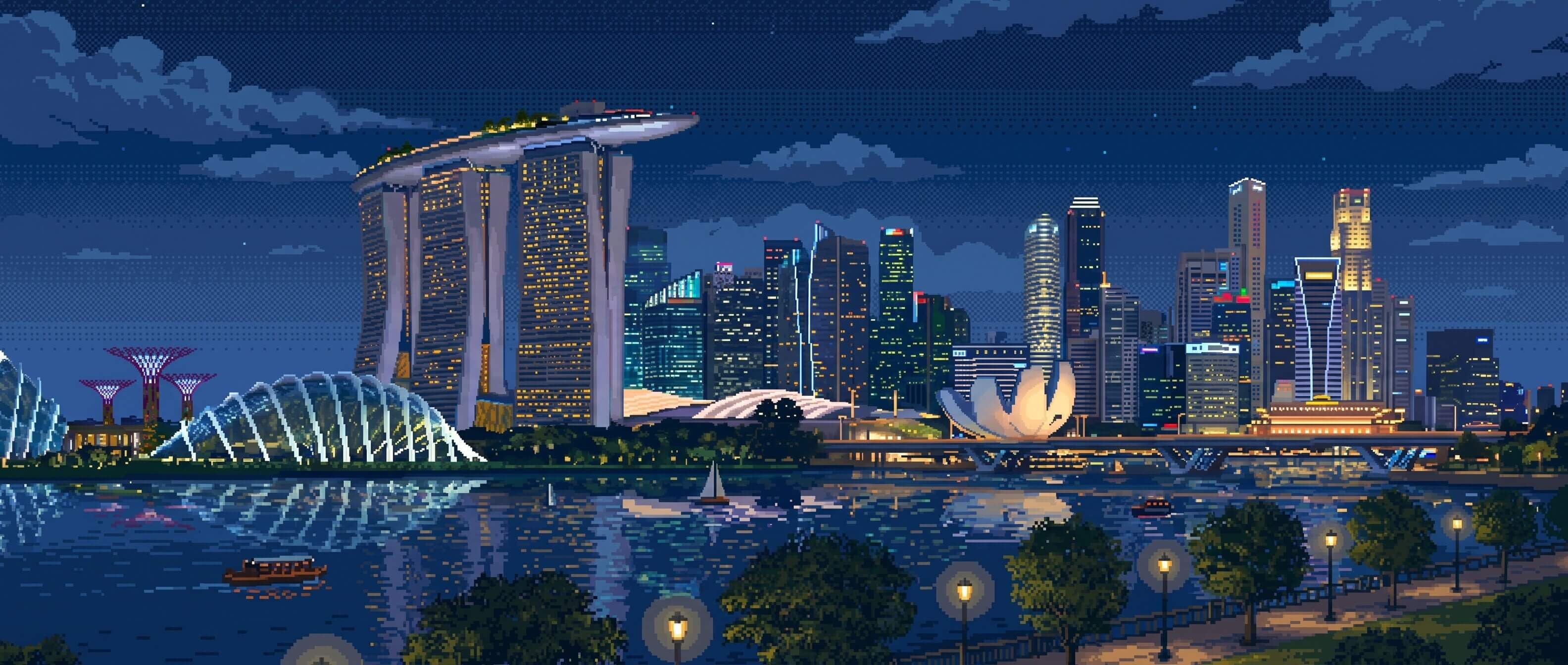
Why there's a picture of Singapore on my homepage
The first thing on this site is a picture of the Singapore skyline at night. No caption. No context. Just Marina Bay glowing over the water, above a line that says Hi, I'm Max.
People ask about it. So here's the long version.
I'm 24. I live in Germany. I spend most of my waking hours doing two things: building software, and working out where to go next. For years I thought those were separate hobbies. One for weekdays, one for the gaps in between. Singapore is where I stopped believing that.
The city reads like a product
I landed at Changi around midnight. Jetlagged, braced for the usual arrivals hall misery.
Instead: through immigration in five minutes. Bag already on the belt. A train into the city that ran like it had somewhere to be.
That sounds like a small thing. It isn't. Airports are where a country shows you what it actually cares about. Changi is a place where somebody clearly sat down and asked which part of this is worst, and whether they could just delete it.
There's an indoor waterfall in the middle of the terminal. Which is ridiculous. Also nobody there is miserable. Both of those are design decisions.
The feeling didn't stop at the airport. The trains are cold, quiet and on time. The signs assume you're lost and answer before you ask. The gaps between buildings are full of trees, not by accident, but because someone in the sixties decided the city would be green and then spent sixty years enforcing it.
I walked around for three days with the same thought on a loop. Somebody built this on purpose.
That's what got me. I build things for a living, so I know what deliberate looks like. Singapore doesn't feel like a city you visit. It feels like a product you're using. You can sense a team behind every decision, arguing about it, shipping it, changing their mind.
Having nothing was the whole point
Here's what makes it interesting instead of just impressive. Singapore started with nothing.
The island is about 730 square kilometres. Smaller than plenty of single cities. No oil. No metals. No farmland worth the name. For decades it couldn't even make its own drinking water and had to buy it from across the strait.
Those are not the opening conditions of a success story. That's a brief you'd politely hand back.
The answer wasn't to go find more resources. It was to treat every missing thing as the actual design problem. No water? Build a closed loop. Catch the rain across two thirds of the island, desalinate, recycle the rest until it's clean enough that they'll hand you a bottle to prove the point. No land? Make some. Then build up. Then build underneath. No natural advantage? Manufacture one out of shipping, law and paperwork until half the world has a reason to stop there.
I think about this constantly when I'm working. Every project I've shipped was shaped more by what I couldn't do than by what I could. No budget. No team. No time. No users yet. The easy move is to call those excuses.
Singapore is a very large argument that the constraint is the brief. The interesting version of a thing only shows up once you stop wishing for the resources you don't have.
The part that isn't glass
If the story ended at the skyline it would be a boring story. Efficient places are usually unlovable. A city that's only a machine is a bad city.
But walk fifteen minutes off Marina Bay and you're in a hawker centre under a ceiling fan. Holding a tray. Eating something that costs less than a coffee back home and beats most thirty euro meals I've ever paid for. Some of those stalls have made exactly one dish for forty years. A whole culture built on doing one thing properly. UNESCO agreed and put it on the heritage list in 2020.
Then there's Tiong Bahru. Low, curved, art deco, quiet in a way the rest of the island isn't. Kampong Glam, with the mosque at the end of a street of fabric shops. Little India, which is loud and cluttered and smells incredible and feels like a different country than the one you were in twenty minutes ago. Katong, with rows of Peranakan shophouses painted in colours no planning committee should ever have signed off on.
Four official languages. Conversations that switch between three of them in a single sentence.
So you get a skyline that looks engineered, sitting directly on top of something older and messier that the engineering had the sense to leave alone.
That's the real lesson, and it's the one I find hardest to pull off in my own work. Build something that runs perfectly and still has a soul. Most software picks one. The polished thing is usually lifeless. The thing with character is usually held together with tape. Singapore refuses to choose, and I've never quite forgiven it for making that look easy.
Travelling is reading someone else's code
Somewhere on that trip the two hobbies collapsed into one.
Going somewhere new is the closest thing I've found to reading a codebase you didn't write. Someone had your exact problems. Move people around. Feed them. Stop them being miserable in the heat. And they solved it differently than you would have.
Sometimes worse. Often better. Almost always in a way that never would have crossed your mind, because you've only ever seen one solution and quietly assumed it was the default.
That isn't a metaphor I'm stretching for a blog post. I rebuilt an onboarding flow because of how a subway handles someone who's lost. I've deleted features because a night market reminded me that the good version of a thing usually does less, better, for longer.
You can't get that sitting at your desk. You have to go stand inside someone else's implementation.
So it stays at the top
That's the picture.
It isn't up there because it's a pretty skyline, although it is. It's up there because it's the clearest reminder I have of what I'm actually trying to do. Build things that work so well they disappear. Out of less than I'd like. Without sanding off the parts that make them worth using.
I don't always manage it. Most of what I make is small, and some of it doesn't survive the month. But it's a good thing to look at before you start.
Also I just love the place. Everything above is true, and it's also a very long way of saying that.